Showing posts with label Technology. Show all posts

August 28, 2026

Courts Cleared AI Shopping Agents. India's Payment Rails Have Not.

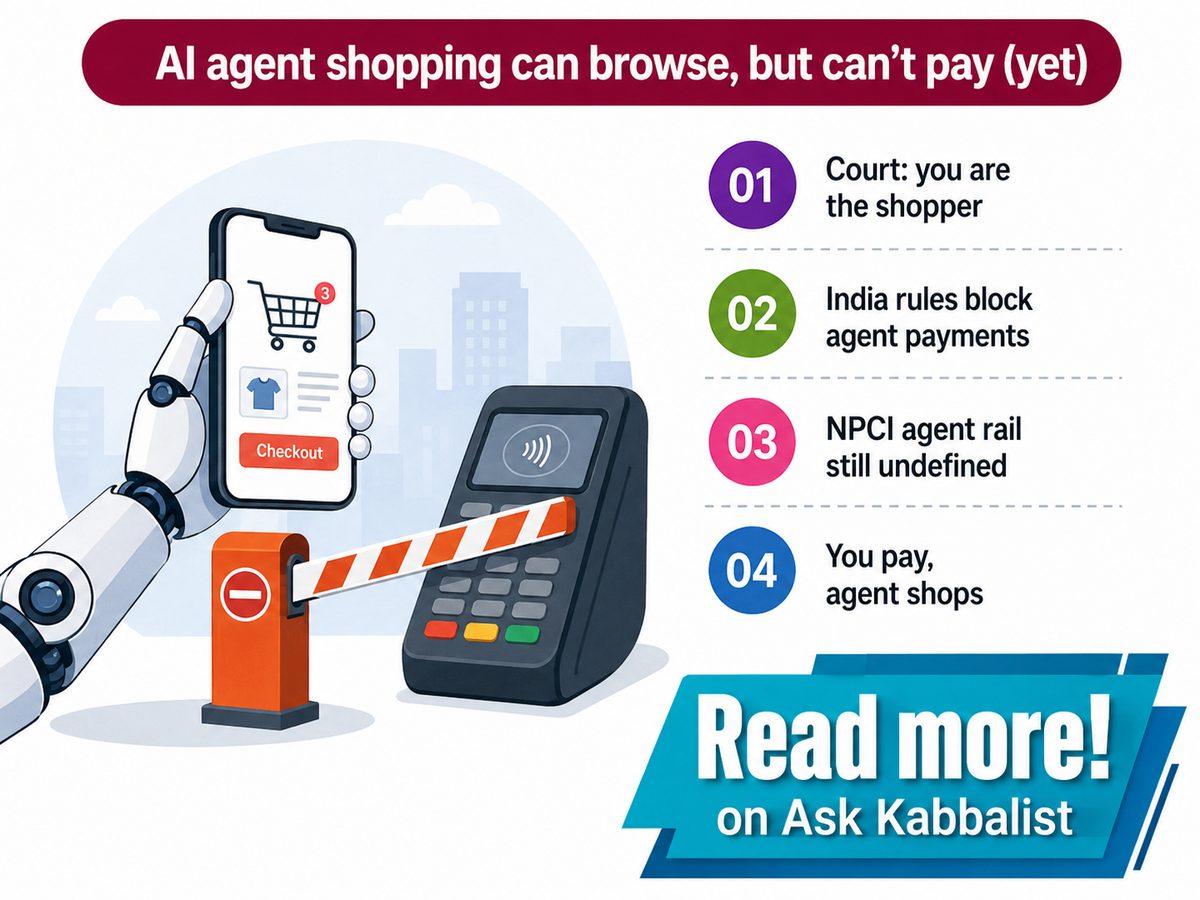
You tell your AI browser to find the cheapest 65-inch TV under Rs 60,000 and buy it. It finds one in about eleven seconds. Then it stops. Not because Amazon blocked it, and not because a judge did. It stops because nothing in India's payment plumbing knows how to let a piece of software hold your wallet.
Courts Cleared AI Shopping Agents. India's Payment Rails Have Not.

TL;DR: A US appeals court has ruled that when you send an AI agent shopping, you are the one visiting the store. That settles one fight and leaves the harder one untouched. In India, no payment rail yet exists that will let the agent pay.

Why It Matters

On 9 March 2026, a federal judge in the Northern District of California ordered Perplexity to keep its Comet browser off Amazon. On 4 August the Ninth Circuit vacated that order in Amazon v. Perplexity, No. 26-1444, and the reasoning is the part worth keeping. Where the AI company's servers never speak to the retailer directly, and every request routes through the shopper's own machine, the panel held that it is the shopper who "accessed" Amazon's computers under the Computer Fraud and Abuse Act. Not the software vendor.

Read the coverage and you would think agentic shopping just won outright. It didn't, quite. The panel left Amazon's contract and tort claims standing, terms-of-service breach included, and went out of its way to say it was not foreclosing liability for agents with greater autonomy, or for designs where the vendor's own servers hit the retailer. So the decision protects one narrow shape: a local agent driving your session, on your hardware, with your login. Build it any other way and you are back in front of a judge with worse facts. There is a second thing the ruling did not do. It did not stop Amazon from blocking agents by other means. Nothing in the opinion obliges a retailer to serve a request it can detect and refuse, and detection is a product problem rather than a legal one. A platform that loses on the statute can still rate-limit, fingerprint, challenge or quietly terminate the account, and none of that needs a judge's permission.

None of which is why your agent stalls at checkout in Bengaluru. The Reserve Bank of India's Digital Payments E-Mandate Framework, in force since 21 April 2026, requires your issuer to notify you at least 24 hours before any recurring debit lands. Sit with that for a second, with an agent in mind. The one rail built for automatic payments comes with a mandatory day of warning attached. It is the same instinct now shaping how platforms decide what software may act on your behalf, applied to money instead of apps, and it lands harder here. E-mandates were designed around a repeating charge whose amount and merchant you already know, on a date fixed well in advance. An agent's entire value is the opposite of that: an unpredictable amount, at a merchant you have never used, on the day it finally finds the thing. The rail and the use case were built for different worlds.

Four numbers frame the standoff: how long the ban actually held, what the retailer stands to lose, how fast agent buying is climbing, and how much of the open web is already machine traffic. Together they explain why Amazon spent five months fighting this, and why losing once has not ended it.

Injunction Held

148 days

Before the panel vacated it

Ad Revenue At Risk

$19.8 bn

Amazon, one quarter of 2026

Agent-Driven Orders

3x

Year on year, second quarter

Machine Traffic Share

1 in 30

Of all web visits, 2026

Take the order growth. Shopify's second-quarter 2026 earnings set it against a figure that matters more: 75% of AI-attributed purchases fell outside the company's top hundred product categories. Agents are not winning the things people already know how to buy. They are finding the awkward, badly-named, three-pages-deep thing you would have given up on by the second search.

"

A payment rail that must warn you a full day before it moves your money was built for gym subscriptions, not for an agent that just found your shoes.

Three Routes, One That Pays

So where does this leave an Indian shopper who actually wants the thing? Three routes exist right now, and the gap between them is not about how clever the model is. It is about who holds the authority to move money and who answers when the money moves wrongly. The third column deserves a note, because it is the one people picture when they hear the phrase. A delegated-payment agent is not an agent holding your password. It is an agent holding its own credential, one your bank recognises as separate from you, spending inside limits you fixed beforehand, leaving a trail that records which instruction came from a human and which from software. That is a great deal of new infrastructure, and not one piece of it is a model-quality problem.

Dimension Local Agent On Your Device Retailer's Own Assistant Delegated-Payment Agent
Legal Status Cleared on 2 statutes, CFAA and California's CDAFA Never at issue, you are the merchant's logged-in user Untested, no agent has settled on UPI rails
Contract Risk 2 claim families survive on remand: contract and tort None, the retailer wrote the terms it is enforcing Undefined until a protocol publishes its terms
Payment Rail Your saved card or UPI, you press the final button Retailer wallet or saved instrument, one tap Reported UPI extension, nothing in production
Auth Interrupt Second factor required above Rs 15,000 per transaction Same threshold, prompt raised on the retailer's screen No published exemption, assume the threshold applies
Purchase Latency Seconds, capped by how fast you type the OTP Seconds, instrument already on file 1 day floor, set by the pre-debit notice rule
Dispute Route Card or UPI chargeback, unchanged by the ruling Retailer grievance desk, then your issuer None defined, chargeback rules still to evolve
Setup Steps 3 steps: install browser, sign in, grant site access 1 step: open the retailer's existing app Not installable, no consumer-facing build exists
Live In India Yes, for search, comparison and cart building Yes, bounded to that one retailer's catalogue No, stakeholder consultation stage only
Best Suited For Comparison hunting where you still approve the buy Repeat orders inside one retailer you already trust Nobody yet, watch the consultation instead

Notice what the table does not contain. There is no column where an agent both chooses freely across the whole market and pays without you. That combination is the product everyone is describing, and in India it currently exists nowhere. The court fight was about the first half. The second half is a payments question, and payments questions in this country are settled by the regulator, not by the Ninth Circuit. It is tempting to read all this as a delay, as though the parts are on order and the launch is a scheduling matter. That reading is too generous. Granting payment authority to a non-human actor is a genuinely hard design question, and the countries working on it are not converging on a shared answer.

1 2 3 4 Agent identity Delegated mandate Payment authority Dispute route Reported, unspecified No published spec Held by the notice rule Still to be written

Four things have to exist before software can pay on your behalf in India: a way to identify the agent, a mandate you actually granted it, authority to move the money, and a route to complain when it goes wrong. Not one of the four is finished.

Friction Points

India does have an answer in progress. Business Standard reported in July 2026, citing industry sources, that the National Payments Corporation of India is building a Unified Agent Protocol to authenticate agents and set transaction limits without rebuilding UPI underneath. That is the right shape. It is also, as of today, a reported development rather than an announced product: no official NPCI statement, no timeline, no pilot, no published limits. The protocol is real, or at least the consultation is; the protocol itself is still slideware.

Which brings up the thing that irritates me about the current commentary. Specific per-transaction caps have been circulating as though they were policy. They are not. They come from one writer's proposal about what NPCI ought to do, and they have been repeated until they read like a specification. If you are planning around numbers nobody at the regulator has published, you are planning around fiction, and the correction will be expensive.

Then there is the hole nobody wants to own. An agent buys the wrong size, the wrong variant, the wrong seller. Under a card payment you dispute it. Under an agent-initiated debit, who is the counterparty: you, because a court just said the agent is your hands, or the vendor, whose model picked the listing? Reporting on the protocol work concedes that chargeback and dispute mechanisms will need to evolve. That concession is doing a lot of work. The same framework already obliges the issuer to send a post-transaction notification carrying its grievance redressal details, which tells you plainly how the regulator pictures recourse: a named human at both ends of every debit. An agent-initiated purchase breaks that assumption at the first step, and no amount of protocol design makes the question of who authorised the spend disappear.

  • Check where the agent actually runs. If it drives your browser on your machine, the Ninth Circuit's reasoning covers you. If it calls the retailer from a vendor's cloud, that protection was explicitly not extended.
  • Read the retailer's terms before you point an agent at it. Contract claims survived this ruling untouched, and account termination needs no court at all.
  • Keep the final confirmation yours. The moment you hand over the button, your chargeback story gets harder to tell.
  • Treat any agent asking for a standing payment mandate as premature. Nothing in India authorises it yet.

Three questions that decide your exposure

Where does it run? The machine the request leaves from is what determines whose legal problem an agent's shopping becomes.

Who presses confirm? Your finger on the last button keeps the dispute path you already understand. Delegating it swaps a known process for one that has not been designed.

What do the terms say? A retailer that bans automated access can close your account tomorrow, and no appellate reasoning about statutes will reopen it.

Use an agent to shop, not to pay. Let it hunt and fill the cart, then check the total yourself and press the button with your own thumb. That is not caution for its own sake, it is the only configuration where you keep both the legal cover the Ninth Circuit just described and the dispute rights India's payment rules already give you. Revisit it the day NPCI publishes an actual specification. Until then, the agent works for you right up to checkout, and that is genuinely useful on its own.
August 25, 2026

Android Sideloading Rules 2026: What Actually Changes For India Now

A friend sends you an APK on WhatsApp. It is a small utility, the kind that never made it to Play because the developer could not be bothered with a store listing. You tap it, Android asks its usual question, you say yes, and it installs. That flow is changing, and most of the coverage has handed Indian readers the wrong date for it.

Android Sideloading Rules 2026: What Actually Changes For India Now

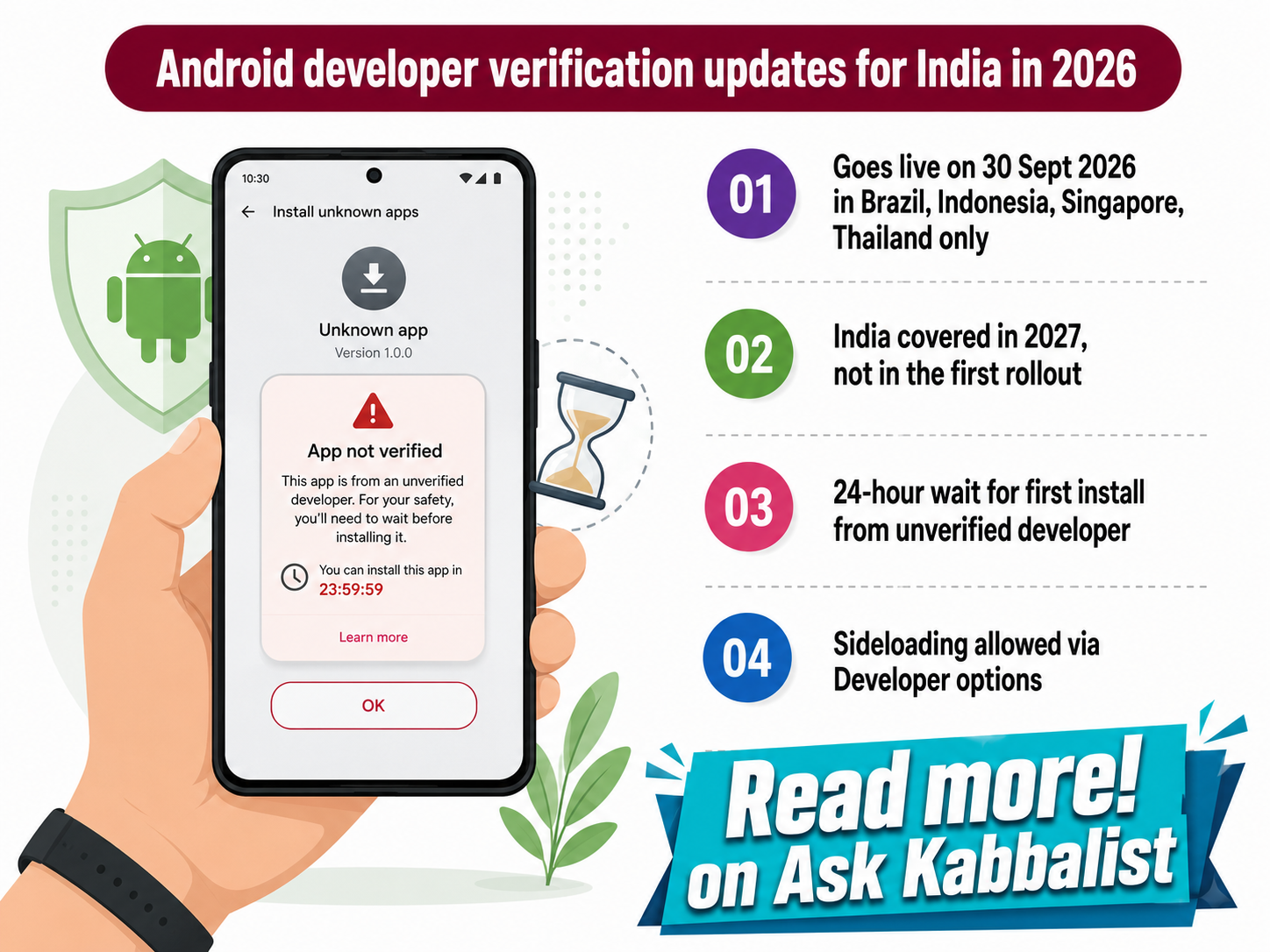
TL;DR: Google's developer verification goes live on 30 September 2026 in Brazil, Indonesia, Singapore and Thailand. India is not on that list and will not be until 2027. What already reaches Indian phones is the advanced sideloading flow, with its one-time waiting period.

Why It Matters

Start with what the rule actually checks. Google is confirming who published an app, not what the app does. No code review, no content pass, no judgment on whether the thing is any good. It is a name-and-document check attached to a signing key, and the practical effect is that anonymous distribution stops being an option on certified devices. Whether you read that as overdue hygiene or as another gate on hardware you already paid for probably depends on how you felt when Apple kept self-service repair out of India using a similar safety argument.

India sits outside the first enforcement wave, and that is doing a lot of work in the coverage. Nothing on an Indian phone becomes uninstallable on 30 September. But look at which stores signed up: Google Play, Samsung's Galaxy Store, Xiaomi's GetApps, OPPO's App Market, vivo's V-Appstore, HONOR and Palm. That is nearly every app store that ships preloaded on a phone sold in this country. StatCounter put Android at 92.44% of India's mobile OS share in July 2026. When the rule does arrive here, it will not arrive at the margins.

The security case is real, and worth stating at full strength rather than waving at. Google's own Android Developers Blog post from 25 August 2025 said its analysis found over 50 times more malware from internet sideloaded sources than from apps available through Google Play. That is Google measuring its own platform, so read it with the appropriate squint, but a gap that size is not a rounding error. The counter-argument is not that the malware is imaginary. It is that identity checks catch the lazy operator and inconvenience the hobbyist, while the organised fraud rings buying stolen KYC documents in bulk carry on. Nobody has published a clean before-and-after on that yet, and until someone does, anyone claiming to know which way it nets out is guessing.

Cooling-off wait

24 hours

Before the first unverified install

Developer fee

$25

One-time full account registration

Hobbyist device cap

20 devices

Free account, no government ID

Play apps auto-registered

99%

Handled without developer action

The waiting period is the number that changes behaviour, and not because it is long. It cannot be completed in the moment. Someone on a phone call telling you to install a file right now, this minute, before your account is frozen, has just been handed a delay he cannot argue you past. That is the same pressure pattern running through the AI voice cloning scams working Indian phone numbers, and a forced pause is a surprisingly rude interruption to it.

"

A one-day pause is not really a defence against malware. It is a defence against urgency, which is what every coercion scam actually runs on.

What Changes And What Does Not

Strip out the speculation and the rule set is small enough to hold in your head. Here is the whole thing, as published on Google's developer verification pages and its Android Developer Console help documentation.

Category Detail What it means
Deadline 30 September 2026 Four countries only, India not included
First wave Brazil, Indonesia, Singapore, Thailand India's turn arrives in 2027
Stores Seven participating stores, Play included Indian phone brands are all inside
Sideloading Still allowed through the advanced flow Buried in developer options by design
Pause A one-time wait before the first install Built to break live coercion scams
Cost A paid full account, or a free limited one Hobbyists trade reach for privacy
Checked Developer identity, tied to a signing key Verification is not app content review
Escape hatch adb installs stay outside the rule Needs a computer and a cable

Read that table twice and the shape of the thing shows up. Google did not close the door. It moved the handle to a place ordinary users will never look, added a delay to the one path that leads there, and left a developer tool untouched for people who own a laptop. Every one of those choices is defensible on its own. Together they describe a device that is a little less yours than it was.

Aug 2025 · Mar 2026 · Aug 2026 · Sep 30, 2026 · 2027 · Rules announced · Console opens · Advanced flow · Four countries · Global rollout ·

Five stops on one line: the policy was announced in August 2025, verification opened to all developers in March 2026, the developer tools and the power-user install path shipped in August 2026, four countries hit enforcement on 30 September 2026, and everything else follows from 2027.

Friction Points

The advanced flow lives inside Developer options, which you reach by tapping the build number seven times. Google is not hiding it out of embarrassment. Burying it is the design. But it produces an odd result: the people most likely to need an app that never reached a store, a regional language keyboard, a niche utility, a local college's attendance app, are frequently the people least equipped to go digging through settings that warn them off at every screen.

Then there is the paperwork gap. An individual developer supplies a government ID. An organisation needs a D-U-N-S number from Dun and Bradstreet first, and that request can take up to 28 days to come back. For a two-person studio in Pune shipping a niche app, the fee is not the obstacle. The month of waiting and the registered-entity requirement are, and they arrive before a single line of the rollout touches India.

One more thing worth flagging, because it gets lost in the outrage cycle. The advanced path is not a one-time switch you flip and forget. Keep an eye on these before you decide the whole thing is overblown:

  • The unverified-install setting can be enabled temporarily for seven days or left on indefinitely, so a temporary grant will lapse without warning you again.
  • The adb route still installs unregistered apps, but it needs a computer, and plenty of Indian users have only ever treated a phone as their whole computer.
  • Google's help text covers new installs only, and says nothing about apps already sitting on your device, so do not assume either outcome.
  • Your phone brand's own preloaded store is on the participating list, so "I never use Play" is not the exemption people think it is.
  • The rollout reaches handsets in stages, so two identical phones in the same house can behave differently this month.

Certified devices only

The rule binds phones that ship with Google services, not every Android build.

Direct distribution survives

Google says developers keep the freedom to ship straight to users or via any store.

Two ways to register

Play Console, or a separate Android Developer Console for anyone who avoids Play.

So: nothing on your phone breaks next month. Use the time. If you rely on an app that lives outside a store, message the developer now and ask whether they have registered, because the answer in 2027 is going to be a lot less negotiable than the answer today. And if you are the sort of person who already keeps a second browser around rather than trusting one company's default, apply the same instinct here and get the file you actually care about onto your device while the door is still easy to open.

July 22, 2026

AI Voice Cloning Scams in India: Your 2026 Survival Guide

The call comes at 2:40 on a Tuesday afternoon. It is your son's voice — the exact pitch, the exact pause before he says "Amma," even that slight nasal edge he's had since childhood. He's been in an accident, he's at a private hospital, the desk won't admit him without an advance, and a "hospital administrator" comes on the line with a UPI handle. Ten minutes later the money is gone. Your son, it turns out, was in a lecture hall the whole time, phone on silent.

AI Voice Cloning Scams in India: Your 2026 Survival Guide

That is not a scene from a Netflix thriller. It is the standard fraud playbook of 2026, and it runs on two rails India built better than almost anyone: cheap AI tools and instant payments. The same UPI stack that lets you split a dinner bill in four seconds also lets a stranger with a cloned voice drain a retirement account before the chai gets cold.

TL;DR: Fraudsters now clone a familiar voice from a few seconds of public audio, fake an emergency, and push you to pay over UPI before you think. No app setting fully protects you. A family code word, a callback rule, and the 1930 helpline are your real defences.

Why It Matters

Start with how little the attacker needs. A wedding video on Instagram, a voice note forwarded to the wrong group, a podcast clip, a birthday reel — any short sample of someone speaking is enough raw material for today's open-source cloning models. The scammer doesn't hack your phone. They harvest your family's public audio, build the clone in minutes on a free tool, and then engineer panic: an accident, an arrest, a stuck visa, a kidnapping. Panic is the product. The voice is just packaging.

The scale has stopped being a niche cybercrime story. Industry tallies put global losses to AI-enabled fraud at roughly $442 billion for 2025, and India sits near the centre of that map because of how thoroughly daily life here runs on WhatsApp and UPI. This has climbed the food chain too — a cloned voice of Bharti Airtel chairman Sunil Bharti Mittal was used in an attempt to move funds through a senior executive. If a scammer will build a deepfake to fool a boardroom, the version aimed at your parents costs them almost nothing.

Here's my first unfashionable opinion: the "be aware, stay alert" poster campaigns banks love are mostly theatre. Awareness assumes the victim has time to think. These scams are engineered to remove thinking time — the fake son is crying, the fake policeman is shouting, the clock is always ticking. Defences that require calm judgment in the moment will keep failing. Defences that were agreed on before the call — a code word, a hard rule to hang up and dial back — actually hold, because they don't depend on you being clever while terrified.

The numbers below are why this deserves space on your family WhatsApp group tonight rather than someday. Each one describes a different edge of the same machine: how little input it needs, what it took last year, how many people reported it, and how fast it is growing.

Audio Needed
3 sec
enough to clone a voice
Reported Losses
₹22,495 cr
Indian cyber fraud, 2025
Complaints Filed
2.81 mn
cybercrime cases, 2025
Growth Rate
+24%
complaints, year on year

Sit with that first cell for a moment. It's less audio than the greeting most of us leave on a voicemail. It means the question "has my voice ever been recorded in public?" now has the same answer for everyone: yes. Planning your defence around keeping voices private is already a lost game — the defence has to work even when the clone is perfect.

The Anatomy of the Scam, Row by Row

Before the table, one piece of context. What police cyber cells describe from 2025-26 case files is not one scam but an assembly line, and every stage has been made easier by an off-the-shelf tool. Reading it as a system explains why no single tip — "check the number", "listen for robotic tones" — is enough on its own.

CategoryDetailWhat It Really Means
Voice sourceReels, voice notes, wedding videosYour family's audio is already public
Cloning toolsFree and open-source appsZero cost, zero skill required now
Face fakesOne photo, under a minuteVideo calls no longer prove identity
Delivery channelWhatsApp calls and fake UPI appsThe scam rides trusted, daily apps
Pressure scriptAccident, arrest, "digital arrest"Urgency is the actual weapon here
Payment railUPI, instant and irreversibleSpeed favours the scammer, not you
Recovery pathHelpline 1930, bank, cybercrime.gov.inReporting fast beats reporting perfectly

The row that deserves your attention is the payment rail. UPI's four-second settlement is a genuine engineering triumph — and in a fraud, every one of those seconds works against the victim. Once money moves through two or three mule accounts, recovery odds fall off a cliff. That is why the practical fight is won or lost in the minutes before you approve a payment, not the days after.

The four-stage pipeline above is the whole crime: only stage three ever touches the victim, which is why interrupting that single moment — with a code word or a callback — collapses everything before it.

Friction Points

Now the uncomfortable part: what still doesn't work. Caller ID apps flag unknown numbers, but these calls increasingly arrive on WhatsApp from freshly created accounts wearing a stolen profile photo. Banks send warnings, but a warning SMS competes with a screaming voice claiming to be your child. And the apps themselves keep getting faked — imitation UPI apps that look pixel-identical to the real thing have travelled across India through WhatsApp forwards. I wrote about how telecom-grade bot support fails customers in an ordinary billing dispute; imagine that same support maze when you're trying to reverse a fraudulent transfer with your hands shaking. In field studies of these cases, one number keeps surfacing: the window between the first ring and the first debit averages around 19 minutes. That's the entire battlefield.

There is also a genuine grey area nobody has resolved, in India or anywhere else: who eats the loss when a victim authorised the payment? Bank rules protect you reasonably well from unauthorised transactions. But a voice-clone victim taps "pay" themselves — tricked, yes, fully authorised, also yes. Regulators are still arguing about where liability should sit, and until that settles, assume the answer is: you do. Which is one more reason the AI tools now embedded in our daily software deserve scrutiny before trust — the same caution I argued for when comparing AI browsers against Chrome earlier this month.

Watch for these tells before any rupee moves:

  • Urgency plus secrecy. "Don't tell anyone, pay now" is the signature of every script. Real hospitals and real police have paperwork, not UPI handles.
  • A refusal to be called back. Hang up and dial the person's actual saved number. A genuine caller survives this test every single time; a clone never does.
  • Payment to an individual for an institutional need. Hospital deposits, court fines and customs fees do not land in a personal UPI ID.
  • Slightly-off audio behaviour. Clones handle interruptions badly. Ask an unexpected question — the pet's name, last Sunday's lunch — and listen for the stall.
Key Takeaways
  • Agree on a family code word tonight — it costs nothing and defeats a perfect clone.
  • Make "hang up, call back on the saved number" a house rule, not a suggestion.
  • Install UPI apps only from official stores; a forwarded APK is an automatic no.
  • If money moves, call 1930 and file at cybercrime.gov.in within the hour — speed decides recovery.

Do one thing before you close this tab: message your family group and set the code word. Not tomorrow. The scammers already have the voice samples — the only question left is whether your family has a script of its own when the phone rings.

July 17, 2026

AI Browsers vs Chrome in 2026: Should You Switch Now

AI Browsers vs Chrome in 2026: Should You Switch Now

You ask your browser to find the three cheapest flights to Delhi, check them against your calendar, and draft a note to the group chat. It does all of it in one pass. No stack of tabs, no copy-paste, no forty-minute rabbit hole. Then a week later a researcher shows how one poisoned link could have told that same helpful assistant to quietly forward your inbox to a stranger. Same tool. Same power. Two very different endings.

AI browsers like ChatGPT Atlas and Perplexity Comet genuinely save time on research and repetitive clicking. But their own makers admit the central security hole, prompt injection, may never be fully closed. Switch for low-stakes work. Keep Chrome for anything tied to money or private accounts.

What These Browsers Actually Do

The browser used to be a window. In 2026 it wants to be an employee. OpenAI's ChatGPT Atlas, Perplexity's Comet, and The Browser Company's Dia all ship with an agent that reads the page you are on, references your other open tabs, and clicks through live sites for you. Google and Microsoft bolted the same kind of agent mode into Chrome and Edge. The pitch is simple: stop doing the boring web chores yourself and let the software handle them.

This is not a chatbot sitting in a side panel. The difference that matters is context and action. A traditional browser with a ChatGPT tab open still makes you shuttle text back and forth. An agentic browser already sees the checkout page, the flight results, and the half-written email, and it can act on all three without you lifting a finger. That shift is why adoption moved fast. AI-driven search sat under a tenth of activity back in 2023. By this year it climbed to a large slice of everyday queries, and roughly half of consumers now say they would rather get a direct answer than a page of blue links.

Those numbers are worth pausing on, because they explain why every major company suddenly wants to own the address bar rather than just the search box.

Time Saved
~12 min
trimmed per research task
Entry Cost
$0
base tier, Atlas and Comet
Rivals in Play
8+
agentic browsers competing now
Search Shift
30%
of queries now AI-driven (2026)

Take that last figure and sit with what it means on the ground. When nearly a third of searches skip the results page entirely, the habit that built Google, scanning a list and picking a link, starts to erode. People stop visiting sites and start asking the browser to read the sites for them. That is a quiet rewrite of how the open web gets used, and it is the real prize these tools are fighting over.

The Trade You're Really Making

Here is where the AI browser vs Chrome question gets honest. You are not choosing between a fast browser and a slow one. You are trading control for convenience. Chrome does what you tell it, click by click, and nothing more. An agentic browser interprets a goal and then makes dozens of small decisions on its own to reach it. When those decisions are booking a table or comparing prices, that is a gift. When a hidden instruction on a web page redirects those decisions, that is a problem nobody has solved.

That problem has a name: prompt injection. Attackers hide commands inside ordinary content, a web page, an email, even the text buried in a URL, and the agent cannot reliably tell your instructions apart from the stranger's. It processes both through the same pipeline. OpenAI said plainly in December 2025 that prompt injection is "unlikely to ever be fully 'solved.'" Read that again. The company building one of these browsers told you the front door does not fully lock. And because the agent can reach your logged-in accounts, a successful attack is not a nuisance popup. It is your email, quietly leaving.

Atlas vs Comet vs Dia vs Chrome, Side by Side

Feature checklists miss the point here. What separates these four is how much they act for you, and how much that exposes you. This table reflects where each one stands in 2026, not a launch-day demo.

Dimension ChatGPT Atlas Perplexity Comet Dia Chrome
Core strength Deep task automation Answer-first research Tidy, focused writing help Speed and stability
Acts on your behalf Yes, extensive Yes, extensive Light Agent mode, opt-in
Multi-tab summarizing Strong Strong Good Basic without add-ons
Underlying AI OpenAI models Perplexity + mixed Multiple models Gemini
Price, base tier Free with ChatGPT Free Free, paid tier above Free
Prompt-injection exposure High when agent runs High, attacks shown Moderate Lower, agent off by default
Maturity in 2026 New, fast-moving New, fast-moving New, narrower Mature, huge base
Best suited for Power users automating chores Heavy researchers Writers wanting less clutter Anyone guarding sensitive accounts

Read across the bottom row and the strategy picks itself. The AI browsers win on doing. Chrome wins on not getting you burned. Most people will end up running both, an agentic browser for grunt work and a locked-down one for banking, and that split is a feature, not a failure.

It helps to see how an attack actually travels, because the mechanics are simpler and nastier than the marketing suggests. Four steps, no malware download, no dodgy attachment, just words on a page the agent was told to trust.

Where It All Goes Wrong

The convenience is real, and so are the failure points. These are not rare edge cases. They are the predictable seams that show up once an agent has real access to your accounts and the open web at the same time.

Security teams have already turned theory into working attacks. Researchers at LayerX demonstrated a technique they nicknamed CometJacking, where a single crafted link could push Comet into pulling data from a user's connected Gmail and calendar and shipping it to an outside server. Brave's own security group reproduced indirect prompt injection inside the same browser. None of this required the user to type anything wrong. They just clicked.

Watch for these before you hand an agent the keys:

  • Account reach. If the browser is logged into your email, bank, or work tools, a hijacked agent inherits all of that access instantly.
  • Invisible instructions. Malicious text can hide in white-on-white page content or query strings you never see, so nothing looks off.
  • No clean fix. This is the honest grey area. Vendors can add guardrails, but they openly say the underlying flaw has no perfect patch, so caution is on you.
  • Silent actions. An agent working in the background can click, send, and share faster than you can notice and stop it.

Keep these four in your pocket before switching:

  • Use different browsers for different risk. Agent for errands, plain Chrome for banking. The split is your cheapest defense.
  • Do not connect it to your primary inbox. CometJacking targeted exactly that link between agent and email.
  • Watch the agent on money tasks. Let it draft and compare, but confirm any purchase or send yourself.
  • Expect the tools to change monthly. They are new. Today's safe setting can move in the next update.

So do not rip out Chrome this weekend. Install one agentic browser, point it at your low-stakes chores, research, shopping comparisons, and messy tabs, and keep every account that touches money or identity on the browser you already trust. Run them side by side for a month, watch what the agent does when you are not looking, and let its behavior, not the keynote, decide how far you hand over the wheel.

March 21, 2026

Apple's Mac Stickies Deserve a Real Fix in 2026

Apple's Stickies app has survived on Mac since System 7.5 — that's over three decades of near-zero meaningful updates. In 2026, recovering a accidentally deleted sticky note still requires digging through hidden Library folders or praying your Time Machine backup is intact. That's not a feature gap, it's a product failure. This article breaks down exactly why Mac Stickies recovery is broken, why millions of users rely on this "forgotten" app daily without knowing how fragile their notes actually are, what Apple should have built years ago, and the specific, no-fluff steps you can take right now to protect your notes before the next accidental close or system wipe costs you hours of work.

Apple Shipped You a Trap and Called It a Feature

You close the Stickies app, you force-quit your Mac during a software update, or you accidentally hit "Delete Note" instead of "New Note." Gone. Every phone number, every half-drafted client idea, every quick list you've been building for three weeks — gone.

And then you Google "how to recover Mac sticky notes" and find yourself staring at a Terminal command directing you to ~/Library/StickiesDatabase, a hidden folder that Apple has never once mentioned in any user-facing documentation.

That's the 2026 Mac Stickies experience.

What You Actually Need to Know Right Now

Mac Stickies stores all notes in a single binary database file at ~/Library/StickiesDatabase. There is no automatic cloud backup, no versioning, no in-app trash, no undo history beyond the current session. If that file gets corrupted or deleted and you haven't manually set up Time Machine or iCloud, your notes are likely gone permanently. Third-party recovery tools exist but they're paid, unreliable, and require you to stop using your Mac immediately after data loss to avoid overwriting sectors.

Thirty Years Old and Still Running on Fumes

Stickies first appeared in Apple's System 7.5 — that's the mid-1990s. The same era as dial-up internet and floppy disks.

Today, in 2026, the app still doesn't have iCloud sync as a default, still ships without a built-in recycle mechanism for deleted notes, and still hasn't been redesigned to match the visual language Apple introduced in macOS Big Sur five years ago. Every other first-party app — Notes, Reminders, Calendar — got the rounded corners, the Continuity features, the iCloud-first architecture. Stickies got nothing.

Think of it like this: imagine your bank's mobile app still looked and functioned like it did in 2003, while every competing app was running Face ID and instant transfers. You'd switch banks. Mac users don't switch because Stickies' core proposition — floating, always-visible notes right on your desktop — is genuinely irreplaceable for a specific type of fast, ambient workflow. There's no direct equivalent. And Apple knows users are stuck.

The app also has zero native keyboard shortcut support for creating new notes. You either click through menus or, if you're technically inclined, write an AppleScript workaround to simulate the action. In 2026. On a machine that sells for $1,299 minimum.

The Reality Gap: What People Think vs. What's Actually True

Common Assumption

Ground Truth

Stickies are backed up automatically

No. They're in a single hidden database file with no native auto-backup 

Closing the app saves your notes

It does — until a crash, force-quit, or OS update corrupts the database

iCloud sync protects your notes

iCloud only covers a 30-day window and requires prior manual setup 

Apple Notes is a drop-in replacement

It lacks the persistent, floating desktop presence that makes Stickies uniquely useful

Time Machine will always save you

Only if you set it up before the data loss, with an external drive connected 

Recovery is simple

It requires Terminal commands, hidden folder navigation, or paid third-party software

Apple's Mac Stickies Deserve a Real Fix in 2026

Where Everything Goes Wrong (The Painful, Specific List)

These aren't edge cases. These are the exact failure points that cost real users real time:

  • The Single Database Problem
    • All notes live in one file:~/Library/StickiesDatabase
    • One file corruption event wipes every note you've ever written
    • There's no individual note export built into the app
    • Recovering one note means recovering the entire database — you can't cherry-pick
  • The Accidental Delete Trap
    • "Delete Note" lives in the Note menu with no confirmation dialog
    • There is no in-app Undo for a deleted note beyond the current session
    • Deleted notes don't go to Mac Trash unless the entire database file is deleted
    • A user who deletes a note and empties Trash loses it permanently without Time Machine
  • The Crash Recovery Nightmare
    • Force-quitting during an update can corrupt the StickiesDatabase file entirely
    • macOS has no built-in mechanism to flag or repair a corrupted Stickies file
    • Users spend an average of two to three hours on a weekend trying third-party recovery tools, most of which require a $29–$49 purchase to actually restore found files
  • The "I Thought iCloud Synced This" Problem
    • iCloud integration exists but is partial, limited to 30 days, and requires prior opt-in
    • Most users discover thisafter they need recovery, not before
    • There's no in-app prompt, warning, or even a Settings menu that explains backup options
  • Design Frozen in Time
    • The app's UI hasn't been updated to match macOS design language since Big Sur launched
    • No support for macOS Sonoma's desktop widget system, which would have been a perfect home for Stickies
    • Font options are limited to a handful that haven't changed in years
    • Translucency mode (Command + Option + T) is the closest thing to a "modern" feature — and it's hidden

What Apple Actually Has the Tools to Build

This isn't a wishlist from someone who doesn't understand product constraints. Apple already ships all the infrastructure needed to make Stickies genuinely great.

The Notes app has iCloud sync, conflict resolution, version history, and a Recently Deleted folder that holds content for 30 days. That entire recovery architecture exists in Apple's codebase right now. Porting even 40% of it into Stickies would eliminate 90% of the data loss complaints on Apple's own community forums.

macOS Sonoma introduced interactive desktop widgets. Stickies, which are by definition desktop-first, persistent, and lightweight, are the single most obvious candidate for widget integration. Apple built the house and left Stickies sitting outside in the rain.

And the keyboard shortcut situation — no native shortcut for "New Note" in 2026 — is genuinely hard to explain. That's a one-line fix in Xcode.

To be fair: there's a real grey area here. Part of Stickies' value is its simplicity. Over-engineering it with AI features, collaboration layers, or a full redesign could destroy what makes it useful. The sweet spot is somewhere between "30-year-old frozen UI" and "Apple Notes with a yellow background," and honestly, nobody knows exactly where that line is. Not even the teams who've been ignoring it.

What You Should Do Before Apple Gets Around to It

Right now, today, before you write another note:

  1. Open Finder → pressCommand + Shift + G → type ~/Library/ → copy StickiesDatabase to a folder in iCloud Drive manually. Do this once a week. It takes 11 seconds.
  2. Set up Time Machine with any external drive. The Stickies file is tiny — under 1MB typically — so backup time is near-instant.
  3. For anything genuinely mission-critical, paste it into Apple Notes simultaneously. Notes has a Recently Deleted folder. Stickies does not.
  4. If you've already lost notes, stop using your Mac and check~/Library/StickiesDatabasevia Finder immediately before any new writes overwrite recoverable sectors.

Apple will eventually touch this app. Maybe macOS 17, maybe later. But until that update ships, the only person protecting your notes is you — and that's a ridiculous position for a company that charges a $200 premium on "it just works."

January 25, 2026

Why Apple Denies India Self-Service Repair even in 2026

Imagine this: It is mid-2026. You are holding your gleaming new iPhone 17 or perhaps the ultra-slim iPhone Air. You bought it from the stunning Apple Store in BKC Mumbai or Select Citywalk Delhi. The experience was premium, the staff was courteous, and the packaging was eco-friendly. But then, disaster strikes—a cracked screen or a degrading battery.

In the United States, the UK, and even Canada (as of last year), a user in this situation has a choice. They can order a genuine repair kit directly from Apple, receive the exact tools used by technicians, and fix the device on their kitchen table.

In India? You have zero official DIY options.

Despite Apple’s massive retail expansion across Indian metro cities and the manufacturing of "Make in India" iPhones, the Apple Self Service Repair India program remains a ghost. For a country with a deep-rooted culture of repair and DIY resourcefulness, this exclusion isn't just an oversight; it is a frustrating gap in the consumer experience. Why are Indian users still forced to navigate a maze of high-cost Authorized Service Providers (AASPs) while the rest of the world gets the keys to the repair kingdom?

Let's dissect why this absence is the worst thing happening to Indian Apple consumers in 2026.

  1. The "Premium" Penalty: High Costs vs. DIY Savings

Why paying ₹33,000 for a screen feels like a punishment.

The primary argument for a self-service store is economic relief. In 2026, the disparity between Indian purchasing power and Apple’s global standard repair pricing has never been more glaring. While Apple has localized iPhone manufacturing, repair pricing remains pegged to global luxury standards, often without the "labor savings" option that self-repair offers.

The Cost of Ownership Paradox

Owning an Apple device in India has always commanded a premium, but maintaining one is becoming financially unsustainable for many.

  • The Price Tag: As of early 2026, an out-of-warranty screen replacement for the iPhone 17 Pro Max hovers around ₹38,900 at authorized centers.
  • The Battery Tax: Simple battery replacements have climbed to nearly ₹9,800.
  • The Gap: In markets with the Self Service Repair Store, consumers can buy the screen bundle for roughly 15-20% less than the full service cost, and more importantly, they save the labor fee. In India, you pay for the part and the mandatory service charge, whether you want it or not.

A Lack of Tiered Options

In a diverse market like India, consumers demand tiers of service.

  • Tier 1: Full white-glove service at the Genius Bar (Premium price).
  • Tier 2: Third-party independent repair (Lower price, varied quality).
  • Tier 3: DIY Official Repair (Cost of parts only).

By denying the third option, Apple forces users into a binary choice: pay an exorbitant fee at an AASP or risk their device with unauthorized parts in the grey market (local markets like Nehru Place or Heera Panna).

The "Genuine Parts" Monopoly

Without a public-facing parts store, "Genuine Apple Parts" in India are strictly controlled. Independent repair shops struggle to source them legally without jumping through expensive hoops to become Independent Repair Providers (IRPs). This artificial scarcity keeps repair prices artificially high. If Apple sold parts directly to you, the consumer, it would naturally cap the price third-party shops could charge, bringing the entire market rate down.

The Trade-In Trap

High repair costs drive a vicious cycle of forced upgrades. When faced with a ₹40,000 repair bill for a two-year-old phone, many Indian consumers simply trade it in for a new one. While this boosts Apple's sales figures, it creates unnecessary e-waste and hurts the consumer's wallet. A self-repair option would extend the lifecycle of these devices significantly.

Why Apple Denies India Self-Service Repair even in 2026

  1. The Right to Repair Facade in India

We have the portal, but do we have the power?

The Government of India launched the "Right to Repair" portal with much fanfare, and Apple ostensibly signed up. However, looking at the situation in 2026, it feels more like compliance theater than actual consumer empowerment.

The Portal vs. The Store

There is a massive difference between information and access.

  • What we have: Apple lists repair manuals and warranty info on the government portal. You can read how to fix your iPhone 17.
  • What is missing: The ability to buy the part mentioned in that manual. Knowing how to replace a battery is useless if the only place to buy a genuine battery refuses to sell it to you.

Global Double Standards

It is difficult to ignore the geographical discrimination.

  • Europe & UK: Full access to parts, tools, and manuals.
  • USA: Established since 2022.
  • Canada: Joined in 2025.
  • India: Still waiting.

Apple often cites "logistics" or "safety" as reasons for slow rollouts. However, India has one of the most sophisticated logistics networks in the world (thanks to e-commerce giants) and a population that is technically literate. The delay in 2026 looks less like a logistical hurdle and more like a strategic business decision to protect high-margin service revenue in a key growth market.

The DIY Culture Mismatch

India is a DIY nation. From fixing appliances to modifying motorbikes, the "Jugaad" spirit is real. Apple’s locked-down ecosystem is culturally antithetical to this. By not offering a structured, safe DIY path, Apple pushes this energy into the grey market, where unsafe repairs (swollen batteries, broken FaceID seals) become common. An official Apple Self Service Repair India store would channel this DIY energy into a safe, sanctioned ecosystem.

Regulatory Pressure is Too Weak

While the EU forced Apple’s hand with USB-C and opened up app stores, Indian regulations on repairability have been "soft guidelines" rather than strict mandates. Until the Indian government mandates that manufacturers must sell spare parts to end consumers (not just service centers), Apple has little incentive to disrupt its profitable service monopoly here.

  1. The Authorized Service Maze

Why "Authorized" isn't enough for a billion people.

Apple will argue that its network of Apple Authorized Service Providers (AASPs) is sufficient. But ask anyone who has tried to get a Mac fixed in a Tier-2 city, and the reality is quite different.

The "Observation" Fee Loop

A common complaint in Indian service centers is the opaque pricing.

  • Diagnosis Costs: Users are often charged a non-refundable "diagnosis" or "observation" fee (ranging from ₹1,500 to ₹3,000) just to be told their device needs a logic board replacement.
  • The Difference: With Self Service Repair, you diagnose the issue yourself using Apple’s online diagnostic tools (available globally). You order exactly what you need. You control the diagnosis.

Turnaround Time Frustrations

Official repairs in India can take anywhere from 3 to 14 days, especially for Mac components or specific iPhone colors not in stock.

  • The DIY Advantage: If you could order the part, you could fix it on a Sunday afternoon. No data wiping (mandatory at many service centers), no handing over your unlocked phone to a stranger, and no waiting weeks for a simple swap.

Data Privacy Concerns

Handing over your device for repair is a privacy risk. In 2026, our phones carry our digital IDs, banking info, and health data.

  • Many Indian consumers are rightfully paranoid about leaving their devices at service centers.
  • Self-repair solves this instantly. Your phone never leaves your sight. For a privacy-focused company like Apple, denying this option in India contradicts their own marketing.

Reach Beyond Metros

Apple’s official stores are jewels in Mumbai and Delhi. But what about an iPhone user in Guwahati, Indore, or Coimbatore?

  • AASPs in smaller cities often have limited inventory.
  • Self Service Repair Store is location-agnostic. As long as a courier can reach your pin code, you have access to the same quality of repair as someone living next to Apple BKC.

Conclusion: It’s Time to Unlock the Repair Store

By 2026, the absence of an Apple Self Service Repair India program is no longer a teething issue—it is a glaring exclusion. We have the official stores. We have the manufacturing. We have the consumers paying premium prices. It is unfair that we do not have the right to repair the devices we own on our own terms.

Apple's reluctance forces Indian consumers into a corner: pay exorbitant fees, risk third-party damage, or contribute to e-waste. For a brand that prides itself on environmental values and customer experience, this is a failure.

The Actionable Takeaway: Don't just wait. If you are frustrated by high repair costs:

  1. Use the Right to Repair Portal: Log your grievances on the government portal to show demand.
  2. Support Independent Pros: Look for IRPs (Independent Repair Providers) who have access to genuine parts, even if they aren't the official "store."
  3. Tweet at Apple Support: Public pressure works. Ask them simply: "The US has had it for 4 years. Why is India still waiting?"