Android Sideloading Rules 2026: What Changes in India
A friend sends you an APK on WhatsApp. It is a small utility, the kind that never made it to Play because the developer could not be bothered with a store listing. You tap it, Android asks its usual question, you say yes, and it installs. That flow is changing, and most of the coverage has handed Indian readers the wrong date for it.
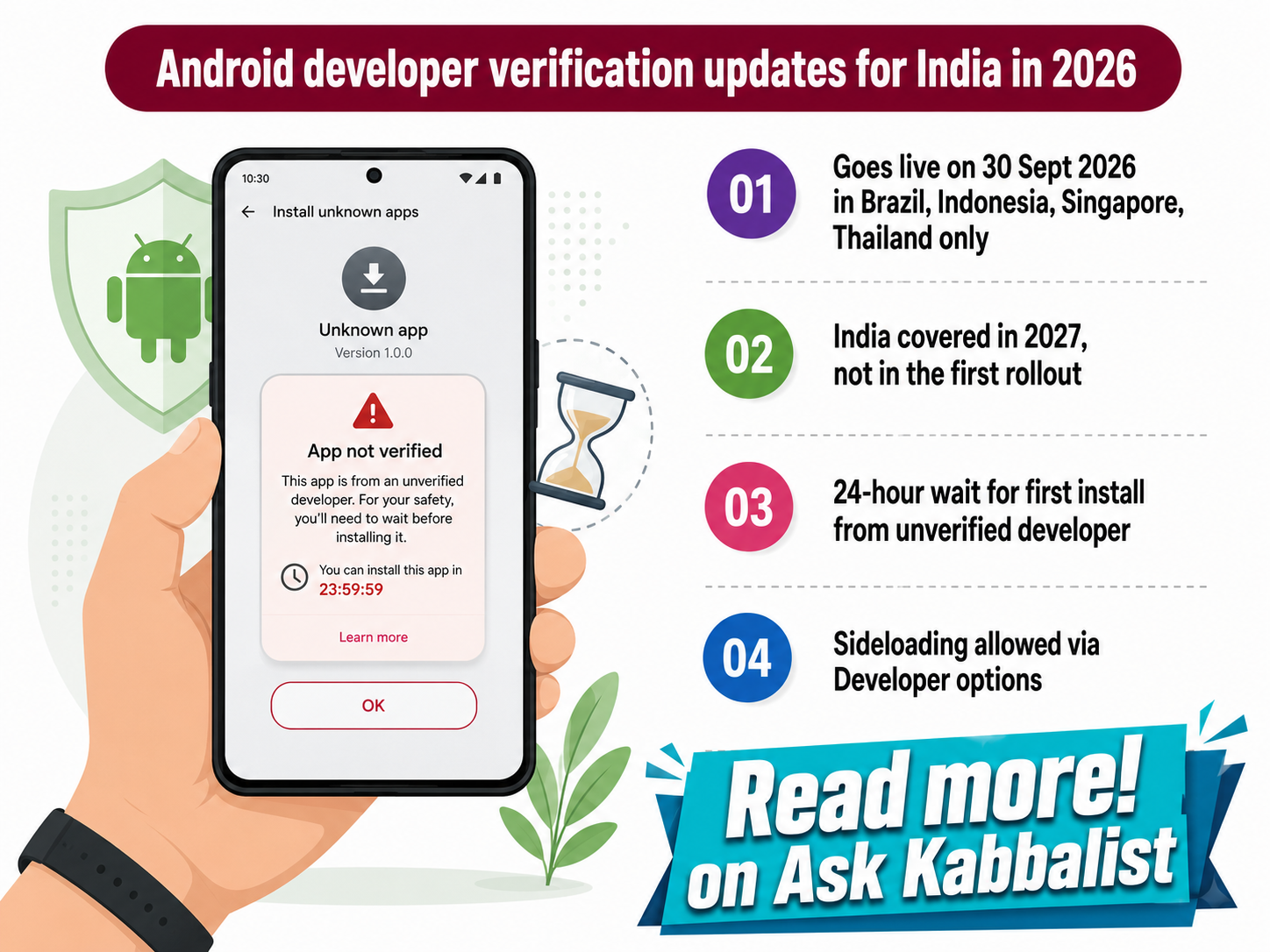
TL;DR: Google's developer verification goes live on 30 September 2026 in Brazil, Indonesia, Singapore and Thailand. India is not on that list and will not be until 2027. What already reaches Indian phones is the advanced sideloading flow, with its one-time waiting period.
Why It Matters
Start with what the rule actually checks. Google is confirming who published an app, not what the app does. No code review, no content pass, no judgment on whether the thing is any good. It is a name-and-document check attached to a signing key, and the practical effect is that anonymous distribution stops being an option on certified devices. Whether you read that as overdue hygiene or as another gate on hardware you already paid for probably depends on how you felt when Apple kept self-service repair out of India using a similar safety argument.
India sits outside the first enforcement wave, and that is doing a lot of work in the coverage. Nothing on an Indian phone becomes uninstallable on 30 September. But look at which stores signed up: Google Play, Samsung's Galaxy Store, Xiaomi's GetApps, OPPO's App Market, vivo's V-Appstore, HONOR and Palm. That is nearly every app store that ships preloaded on a phone sold in this country. StatCounter put Android at 92.44% of India's mobile OS share in July 2026. When the rule does arrive here, it will not arrive at the margins.
The security case is real, and worth stating at full strength rather than waving at. Google's own Android Developers Blog post from 25 August 2025 said its analysis found over 50 times more malware from internet sideloaded sources than from apps available through Google Play. That is Google measuring its own platform, so read it with the appropriate squint, but a gap that size is not a rounding error. The counter-argument is not that the malware is imaginary. It is that identity checks catch the lazy operator and inconvenience the hobbyist, while the organised fraud rings buying stolen KYC documents in bulk carry on. Nobody has published a clean before-and-after on that yet, and until someone does, anyone claiming to know which way it nets out is guessing.
Cooling-off wait
24 hours
Before the first unverified install
Developer fee
$25
One-time full account registration
Hobbyist device cap
20 devices
Free account, no government ID
Play apps auto-registered
99%
Handled without developer action
The waiting period is the number that changes behaviour, and not because it is long. It cannot be completed in the moment. Someone on a phone call telling you to install a file right now, this minute, before your account is frozen, has just been handed a delay he cannot argue you past. That is the same pressure pattern running through the AI voice cloning scams working Indian phone numbers, and a forced pause is a surprisingly rude interruption to it.
A one-day pause is not really a defence against malware. It is a defence against urgency, which is what every coercion scam actually runs on.
What Changes And What Does Not
Strip out the speculation and the rule set is small enough to hold in your head. Here is the whole thing, as published on Google's developer verification pages and its Android Developer Console help documentation.
| Category | Detail | What it means |
|---|---|---|
| Deadline | 30 September 2026 | Four countries only, India not included |
| First wave | Brazil, Indonesia, Singapore, Thailand | India's turn arrives in 2027 |
| Stores | Seven participating stores, Play included | Indian phone brands are all inside |
| Sideloading | Still allowed through the advanced flow | Buried in developer options by design |
| Pause | A one-time wait before the first install | Built to break live coercion scams |
| Cost | A paid full account, or a free limited one | Hobbyists trade reach for privacy |
| Checked | Developer identity, tied to a signing key | Verification is not app content review |
| Escape hatch | adb installs stay outside the rule | Needs a computer and a cable |
Read that table twice and the shape of the thing shows up. Google did not close the door. It moved the handle to a place ordinary users will never look, added a delay to the one path that leads there, and left a developer tool untouched for people who own a laptop. Every one of those choices is defensible on its own. Together they describe a device that is a little less yours than it was.
Five stops on one line: the policy was announced in August 2025, verification opened to all developers in March 2026, the developer tools and the power-user install path shipped in August 2026, four countries hit enforcement on 30 September 2026, and everything else follows from 2027.
Friction Points
The advanced flow lives inside Developer options, which you reach by tapping the build number seven times. Google is not hiding it out of embarrassment. Burying it is the design. But it produces an odd result: the people most likely to need an app that never reached a store, a regional language keyboard, a niche utility, a local college's attendance app, are frequently the people least equipped to go digging through settings that warn them off at every screen.
Then there is the paperwork gap. An individual developer supplies a government ID. An organisation needs a D-U-N-S number from Dun and Bradstreet first, and that request can take up to 28 days to come back. For a two-person studio in Pune shipping a niche app, the fee is not the obstacle. The month of waiting and the registered-entity requirement are, and they arrive before a single line of the rollout touches India.
One more thing worth flagging, because it gets lost in the outrage cycle. The advanced path is not a one-time switch you flip and forget. Keep an eye on these before you decide the whole thing is overblown:
- The unverified-install setting can be enabled temporarily for seven days or left on indefinitely, so a temporary grant will lapse without warning you again.
- The adb route still installs unregistered apps, but it needs a computer, and plenty of Indian users have only ever treated a phone as their whole computer.
- Google's help text covers new installs only, and says nothing about apps already sitting on your device, so do not assume either outcome.
- Your phone brand's own preloaded store is on the participating list, so "I never use Play" is not the exemption people think it is.
- The rollout reaches handsets in stages, so two identical phones in the same house can behave differently this month.
Certified devices only
The rule binds phones that ship with Google services, not every Android build.
Direct distribution survives
Google says developers keep the freedom to ship straight to users or via any store.
Two ways to register
Play Console, or a separate Android Developer Console for anyone who avoids Play.
So: nothing on your phone breaks next month. Use the time. If you rely on an app that lives outside a store, message the developer now and ask whether they have registered, because the answer in 2027 is going to be a lot less negotiable than the answer today. And if you are the sort of person who already keeps a second browser around rather than trusting one company's default, apply the same instinct here and get the file you actually care about onto your device while the door is still easy to open.
Related: How to use DigiYatra now that the face scan is mandatory for international flyers
No comments:
Post a Comment
Note: Only a member of this blog may post a comment.