Microsoft 365 Family Copilot Leaves Five Out
Microsoft sells its Family plan as one subscription for up to six people, and since early 2025 it has sold that plan with Copilot built into Word, Excel and PowerPoint. Now open Word on your partner's laptop. They're signed in with their own account, on your plan, and the Copilot button asks them to buy something. That is Microsoft 365 Family Copilot as it actually behaves: the price covers the household, the AI covers whoever pays the bill.
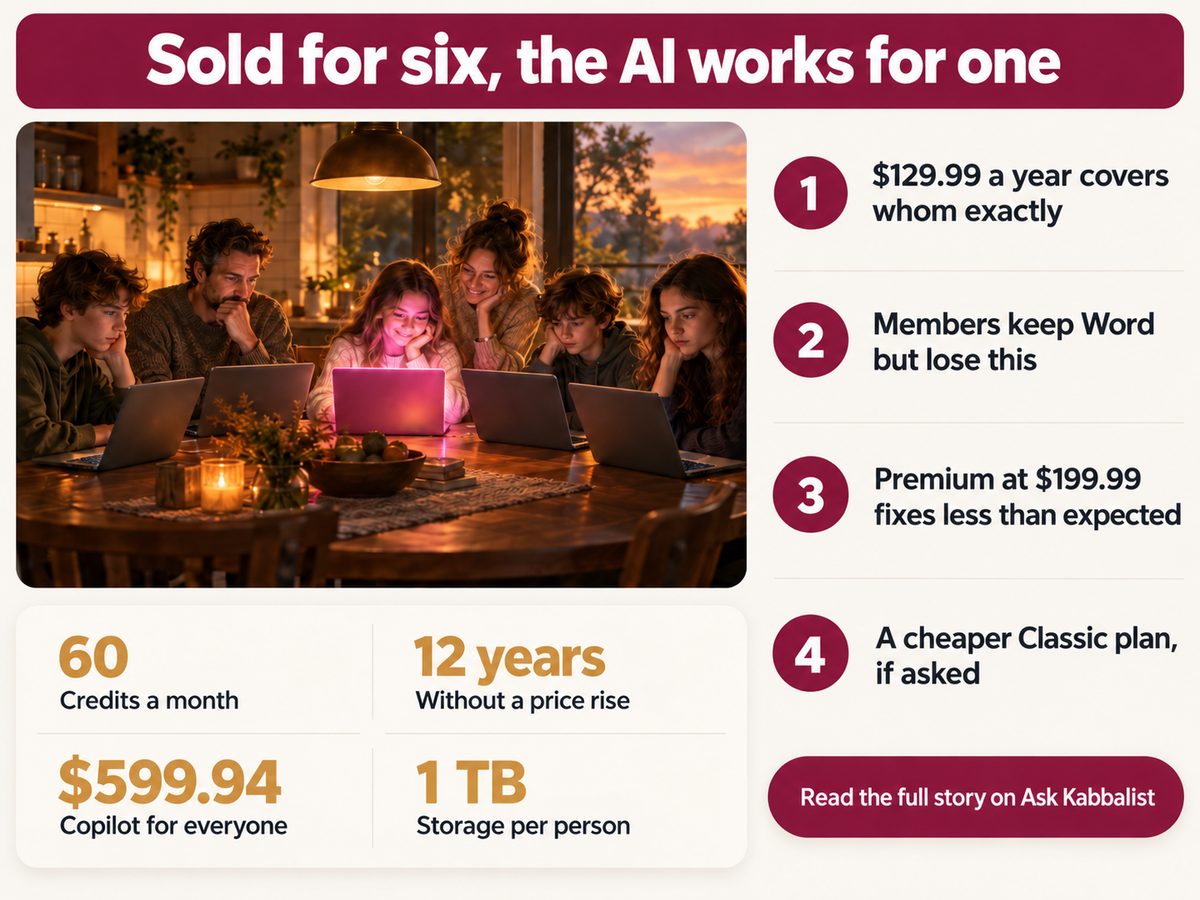
TL;DR: On a Family plan, Copilot inside the Office apps works for the subscription owner only, and no consumer upgrade changes that.
- The five people you share with keep the apps and their own storage, but not Copilot in Word, Excel, PowerPoint or Outlook.
- Premium raises the owner's Copilot allowance and adds no AI for anyone else.
- The only way to give a member Copilot in the apps is their own Personal plan.
- An owner who barely uses Copilot should try cancelling first, because Microsoft may offer a cheaper Classic plan without AI.
Why does Microsoft 365 Family Copilot stop at the owner?
Microsoft licenses the AI features in Word, Excel, PowerPoint, Outlook and Designer to the person who pays, so family members share the apps and storage while the in-app AI answers to the owner's account alone.
Microsoft's own Copilot FAQ for Family and Personal subscriptions says it without hedging: those AI features "are only available to the subscription owner and cannot be shared with others" (retrieved 30 September 2026). At the kitchen table that reads simply. Your teenager drafting an essay and your partner building a budget both see the button. Neither can use it on your plan.
I think this is the most wasted opportunity in Microsoft's consumer lineup. Family puts Office in front of people who would never pay for it, exactly the audience Copilot needs to win. Members get the free Copilot chat app instead, and nothing inside their documents. The throttling logic is familiar from what a $20 AI chatbot plan buys before it throttles; here the limit isn't how much you use, it's who you are.
Designer is on the same list, so a member making a school poster should look at our Figma AI, Adobe Firefly and Canva Magic Studio comparison instead. Why Microsoft drew the line at the owner isn't documented. My read, and it is only opinion, is a compute-cost decision dressed as a licensing rule.
Four numbers decide whether the rule is an annoyance or a bad deal. NBC News reported in January 2025 that Microsoft raised consumer prices as Copilot entered the apps; Office Watch reported the Family plan's monthly AI credits in March 2026. The last cell is my own division of the increase by a year of credits.
Years Without a Price Rise
12 years
Ended when Copilot arrived
Family Plan Increase
$30 a year
Billed for AI one person uses
Owner's Monthly AI Credits
60 credits
The whole household's allowance
Price per Credit
About 4 cents
Only if the owner spends all
The credit allowance bites hardest. It isn't a pool split six ways. It belongs to the owner and resets monthly, so a family picturing Copilot helping with homework is really looking at one person's quota.
Every sharing household paid for Copilot's arrival. Only the person on the bill can open it.
Family or Premium: which plan fits a shared household?
Family suits most shared households, because Premium only raises the owner's own Copilot allowance; neither plan lets the other five members use Copilot inside Word, Excel, PowerPoint or Outlook.
The usual forum advice is to step up to Premium. It isn't a fix: Microsoft's pricing page prints the same owner-only footnote under both plans.
| Dimension | Family vs Premium | What it means for you |
|---|---|---|
| 💰 Yearly price | Family $129.99 a year Premium $199.99 a year |
⚠️ $70 more buys the owner more use |
| 💰 Cost per seat | Family $21.67 each, six seats Premium $33.33 each, six seats |
✅ Office stays cheap when split |
| 🔋 Storage | Family 1 TB per person Premium 1 TB per person |
✅ Members lose nothing on files |
| 📊 Owner's AI use | Family fixed monthly credits Premium extensive, no monthly cap |
⚠️ Worth paying only past the cap |
| 🔒 AI for members | Family none in the apps Premium none in the apps |
❌ Upgrading adds no Copilot seat |
| 🛠 Member fallback | Family free Copilot chat Premium free Copilot chat |
⚠️ Help sits outside the document |
| 🧾 Cheaper exit | Family Classic, $99.99 if offered Premium drop back to Family |
⚠️ Classic tends to surface at cancel |
| 🏁 Best suited for | Family owner uses it weekly Premium owner drafts daily |
🏁 Neither, if a member needs Copilot |
Premium earns its extra cost in one case: the owner runs out of credits most months. For anyone else, the route to Copilot in the apps is Microsoft 365 Personal, listed at $99.99 a year for one person.
Copilot in the apps for all six people costs $599.94 a year through six Personal plans, about 4.6 times the Family price, so buy it only for the member who would really use it. Derived from Microsoft's US list prices, retrieved 30 September 2026.
What catches sharing households out
The owner-only rule catches households twice: at renewal, when an AI-era price arrives for a plan where one person gets the AI, and at homework time, when a member finds the Copilot button asking them to subscribe.
No consumer tier fixes it. Even Microsoft 365 Pro, at $99.99 a month and pitched on "highest usage", carries the same owner-only footnote. At that price, a plan sold to six people should at least let the owner assign seats.
The cheaper exit isn't advertised. Office Watch reported in January 2026 that Classic plans, which drop Copilot, "might be offered to people who try to cancel". It's a retention offer, not a menu item. Members keep the free Copilot app, and the AI browsers we compared against Chrome cover a lot of that ground for nothing.
- A member's Copilot prompt in Word leads to a purchase page, not to your plan.
- Classic removes Copilot for the owner too, so check your own use before asking for it.
- A member who buys Personal while staying on your plan pays twice for apps and storage, so free up their seat.
Check these before your renewal date
- You opened Copilot inside Word or Excel last month. If not, ask about Classic.
- You hit the credit limit more than once this year. Only then does Premium pay.
- A member works in Word or Excel most weeks and has asked about Copilot. Move them to Personal.
This week, before the plan renews, ask the household one question: who actually wants Copilot inside their documents? If it's one person, move them to their own Personal plan. If it's only you and you rarely touch it, start a cancellation and see whether Classic appears. Either way, stop paying for Premium on the theory that it shares.