AI Chatbot Usage Limits: What Your $20 Buys
The plan card promised expanded messages. What it delivered, four hours into a Tuesday, was a grey banner and a wait. Nothing on the page you paid from said how many messages you had, or when they came back. That is the shape of AI chatbot usage limits in 2026: the price is a number, the allowance is an adjective.
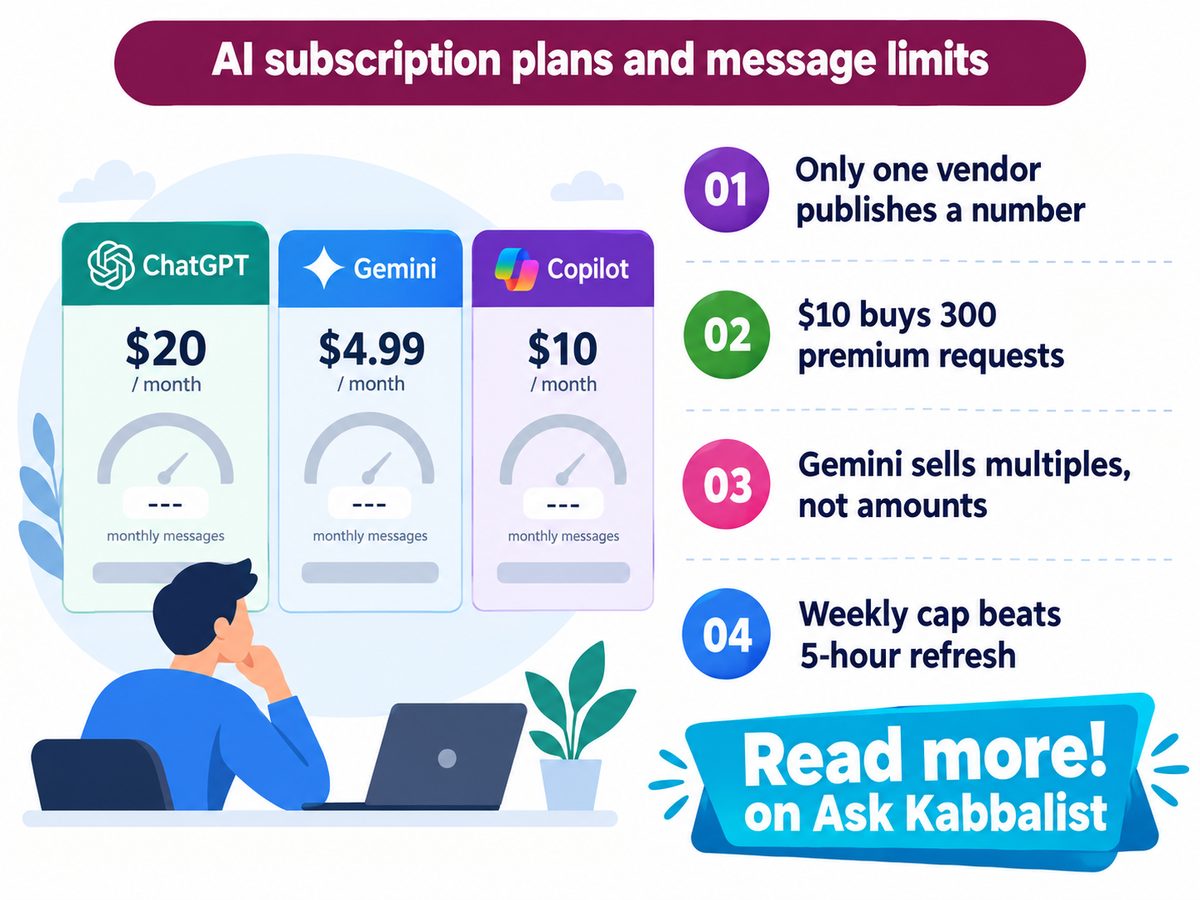
Key Takeaways: only one of the three big vendors prints a number you could check a bill against.
- GitHub counts Copilot in premium requests and publishes the monthly number.
- Google sells multiples of a base it never publishes, so a higher tier stays unknown.
- OpenAI describes its allowance in adjectives and hides the real limits behind a link.
- Size any upgrade against your heaviest week; the average week never causes the lockout.
Why do AI chatbot usage limits stay unpublished?
Because an unpublished ceiling can move: vendors size capacity week to week, and a printed number becomes a promise they must honour or explain, while an adjective can be quietly re-tuned overnight.
Look at what OpenAI's pricing page commits to. Plus is sold as expanded messages and uploads, with "Limits apply" set as a link rather than a figure. Free is "unlimited text chats, subject to abuse guardrails". So, in almost identical words, is Pro. When the cheapest tier and the dearest carry the same qualifier, the qualifier has stopped meaning anything.
This is not new, and not confined to chat. It showed up in the AI browsers that promised to replace Chrome, and it runs through the Figma AI versus Adobe Firefly comparison as well: a monthly price, a vague noun, and the ceiling written where no buyer looks.
Google is the interesting middle case, or the frustrating one, depending on whether you are comparing or buying. Its subscription page publishes precise prices and deliberately imprecise allowances: every paid tier is a multiple of a free tier whose own number is never stated. The four figures below are the ones that decide whether a plan fits your month, and they come from Google's subscription page and GitHub's billing documentation, both read on 21 September 2026.
How Often Gemini Refills
Every 5 hours
Weekly ceiling still ends the week
Copilot Cost Past The Cap
$0.04 per request
The only unit price anyone prints
Copilot Pro+ Monthly Allowance
1,500 requests
A ceiling you can actually count
Gemini's Top Multiplier
20x
Best rate, worst entry price
The refresh window is the figure people misread. A rolling reset sounds forgiving, because something comes back several times a day, but it sits under a weekly ceiling that does not roll. Spend hard on Monday and the window still opens on Thursday with nothing left to refill it. It is the design, not a bug, and it rewards flat workloads.
Four cents a request is the only unit price any of these three vendors will print. Everything else you buy is a multiple of a number they have chosen not to publish.
What twenty dollars a month actually buys
At the twenty dollar mark you are buying either a multiple of an unpublished number or nothing published at all, because the only vendor here that prints a countable allowance does not sell a tier at that price.
Two ladders, side by side. Every figure below comes from Google's subscription page or GitHub's billing documentation, except the break-even in row six, which is ours. OpenAI has no column because its plan cards carry no allowance figure to put in a cell.
| Dimension | Google Gemini plans | GitHub Copilot plans | What it means for you |
|---|---|---|---|
| Entry paid tier | $4.99 a month | $10 a month | Cheaper to start, not cheaper per unit. |
| What it buys | 2x the free tier, base unpublished | 300 premium requests a month | One number divides into your week; one cannot. |
| The $20 tier | $19.99 for 4x free usage | No tier at this price | Four times the entry price, twice the multiplier. |
| Top consumer tier | $99.99 for 5x the $20 tier | $39 a month, the individual ceiling | Only one vendor sells headroom above $40. |
| Running over | You wait for a refresh | Billed per extra request, work continues | Waiting costs hours, billing costs forecastable money. |
| Upgrade break-even | Not computable, base unpublished | About 1,025 requests a month, ours | You can time an upgrade on one side. |
| Best Suited For | Even weeks, and patience during a lockout | Anyone who must explain the AI bill | Only one column gives a number before you pay. |
That break-even is ours, not GitHub's, and it is the only upgrade decision here you can calculate rather than guess. Take the gap between the two Copilot tiers, divide by the published overage rate, and you land near 1,025 requests a month. Under that line, pay the overflow. Over it, upgrading pays for itself.
Across the ten consumer tiers these vendors sell, only two state an allowance you could check a bill against. Counted by hand from the pricing pages named above, read on 21 September 2026.
Do AI plan limits reset daily or weekly?
Both, and that is the problem: Google refreshes on a rolling window that sits inside a weekly cap, GitHub resets on your monthly billing date, and OpenAI publishes no reset schedule you could plan a working week around.
There is a second catch buried in the Copilot figures. GitHub's billing documentation scopes those published request counts to subscribers on an existing annual plan who stayed on legacy premium-request billing after 1 June 2026. The count is real and checkable. It is also grandfathered, so a buyer signing up today may not be on that plan.
My own read, and this is a stance rather than a finding: the vague multiplier is less a transparency failure than a capacity hedge. A vendor that cannot predict its own inference costs will not print a ceiling it may have to defend. Understandable. It still leaves the buyer holding the uncertainty, the same trade as when courts cleared AI shopping agents to buy on your behalf: the capability shipped, the accountability did not.
- A weekly ceiling under a rolling reset means a heavy Monday can cost you Thursday.
- A multiple of a base that quietly shrinks is a cut nobody has to announce.
- Check which plan your signup date put you on, not the one the documentation describes.
Four things to check about your own month before upgrading.
- You can name your plan's allowance without opening a help article.
- Your heaviest week runs roughly double your average, not barely above it.
- A lockout at three in the afternoon would cost you something real.
- Somebody other than you sees this invoice and will ask about it.
So do this before your next billing date. Open the limits page your plan links to, write down the one number or multiplier it gives, and divide it by your heaviest week. If it will not divide, because there is no number, you have learned the most useful thing about that plan: you are renting an adjective, not buying an allowance. Decide on that, not on the plan card.
No comments:
Post a Comment
Note: Only a member of this blog may post a comment.